If you have made it to Nepal with a valid tourist visa and have decided to go for a trek, then you need to understand that there is more paperwork awaiting you after immigration.
I am talking about permits, registrations, TIMS Cards, and much more. All the best treks in Langtang require you to have the necessary permits.
In this blog, we have covered the permit requirements for two different activities: trekking and expeditions within Langtang National Park. And if you think that these paperworks are just a formality, then let me change that perspective of yours.
Apart from ensuring your safety in the Himalayas, the permits and other documentation ensure that you and everyone in your team are part of a responsible and sustainable journey. Because your data is not just about documenting your presence, it is also required to promote conservation and trail management.
So, stay with us until the end of this blog to learn more about the permits that are required if Langtang National Park is on your bucket list this year!
Route-Wise Permit for Langtang Region
In this section, you will find different tables that provide you with information on which permits you need to obtain as you prepare for your trek within Langtang National Park:
|
Activity
|
Required Permits
|
|
Langtang Valley Trek
|
Langtang National Park Entry Permit (LNPEP)
|
|
Gosaikunda Lake Trek
|
Dhunche to Dhunche / Via Dupcheshwor - Talu Village Route
|
LNPEP
|
|
Sundarijal to Dhunche / Dhunche to Sundarijal
|
LNPEP and Shivapuri National Park Entry Permit (SNPEP)
|
|
Langtang Gosaikunda Trek
|
Via Syaprhu Bensi / Dhunche / Dupcheshwor
|
LNPEP
|
|
Via Sundarijal
|
LNPEP and SNPEP
|
|
Tamang Heritage Trek
|
LNPEP and Restricted Area Permit (RAP)
|
|
Helambu Circuit Trek
|
LNPEP and SNPEP
|
|
Ama Yangri Trek
|
LNPEP
|
|
Panch Pokhari Trek
|
LNPEP
|
|
Jugal Himal Base Camp Trek
|
Via Panch Pokhari
|
LNPEP
|
|
Via Bagam-Bhairabkunda
|
LNPEP and Gaurisankhar Conservation Area Permit (GCAP)
|
|
Ganja La Pass Trek
|
LNPEP
|
|
Tilman Pass Trek
|
LNPEP
|
|
Extended Langtang Valley Trek (Tamang Heritage, Gosainkunda, Helambu Circuit)
|
LNPEP, SNPEP, and RAP
|
TABLE 1: Permits required for different treks in Langtang National Park.
Note: Children below the age of 10 are exempt from the permit regardless of their nationality. Furthermore, if your itinerary requires you to go through more than one national park or conservation area, you must pay for the permit for all areas that you will be crossing. More about costs in the respective sections below!
Permits Required for Trekking in the Langtang Region
You have seen in the previous section that the national parks and conservation areas have entry permits. You might also have a general idea as to why these permits have been introduced, but let me give you a better explanation and background.
For someone paying for the entry permits, you might be wondering, “Where is the money going?”
As a tourist, if you are entering national parks and conservation areas in Nepal, your two main purposes could be either observing wildlife or trekking. This section answers your question with regard to the latter option: trekking.
The funding raised from the permits plays a major role in trail infrastructure and waste generated by local teahouses serving food and drinks to trekkers. In a developing nation where funding must be prioritized for almost every sector, the government alone cannot take over the huge responsibility of protecting the rare flora and fauna.
Additionally, the trails you take are home to some of the most unique cultures in the world. So, in order to prevent and preserve the unique trails and natural resources of the nation, the permit system has been implemented.
This is not only for nature but also for you, a trekker in the wild. The permit, paired with the TIMS Card, allows the related bureaus to keep track of your movement for your own safety.
Nepalese people pay a significantly lower amount for permits because it is a part of their own heritage. In the case of foreign trekkers, the permits, although priced higher, remind them to be responsible travellers.
For your trek in Langtang Region, the Langtang National Park Permit is mandatory regardless of the trail's overall difficulty level or duration. Apart from this permit, based on the route you take, you might have to pay for other permits as well, which are clearly mentioned in the section below.
Important: Every foreign trekker (including SAARC nationals) needs to show their passport or an ID card to apply for the entrance permits.
Langtang National Park Entry Permit
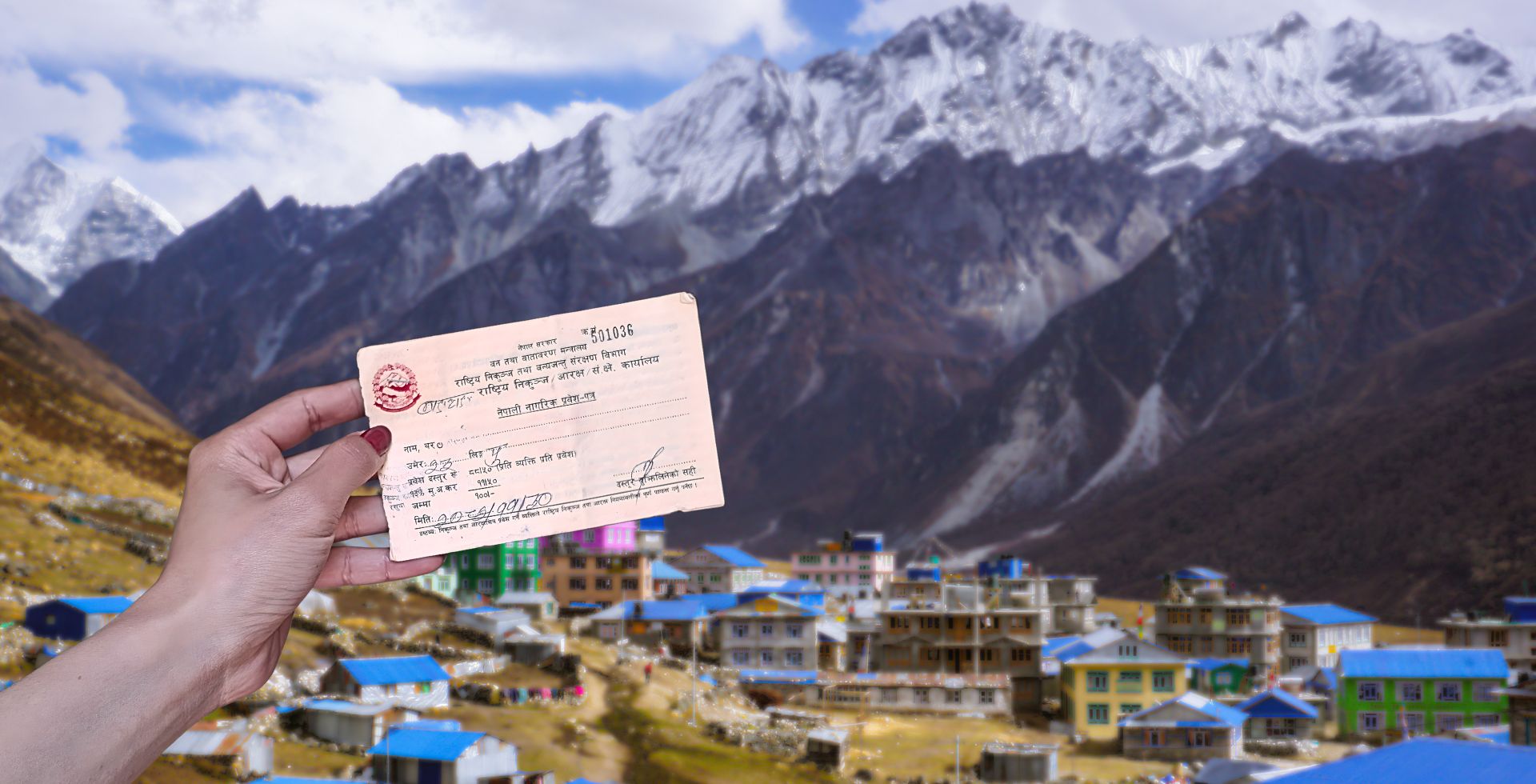
An entrance permit for Langtang National Park is needed in order to enter the premises of this protected zone.
You have two options to obtain the permit. You can either get it before you reach Rasuwa, at the Tourist Service Center, Bhrikutimandap, Kathmandu, or at the entry points of the National Park.
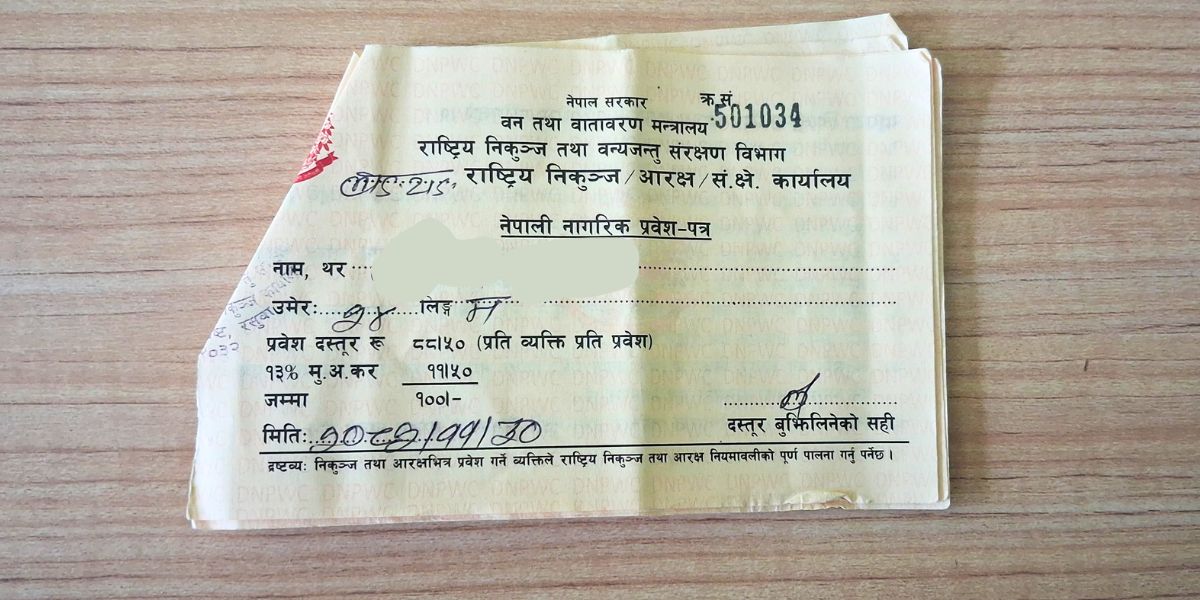
At the entry point, your permit is issued by the Department of National Park and Wildlife Conservation (DNPWC). In Kathmandu, the issuing department is NTB.
Many tourists often get their permit for Langtang Valley and Gosaikunda treks at the army checkpoint in Dhunche. And while permit checkpoints existed in Mailung and Syaphru Bensi as well, they were swept away by the August 2026 Bhotekoshi flood.
If you’re planning to enter the Langtang region via Nuwakot district, there’s a checkpoint in Dupcheshwor/Talu Village Gate too.
Other entry points are in Sindhupalchok district too. For example, in the Helambu and Panch Pokhari regions, you can find the checkpoints in Kutumsang, Mangengoth, and Bhotang.
Note: For those who are wondering if one can apply for the Langtang National Park entry permit online, the website of the Department of National Parks and Wildlife Conservation (DNPWC) is testing out a feature. While it’s not currently possible to get your permits online, let’s hope that the feature becomes accessible in the future.
The cost for the Langtang National Park Entrance Permit varies based on nationality. Here are the details:
- Foreigners: NPR 3000
- SAARC: NPR 1500
- Nepalese: NPR 100
Moreover, you need to pay NPR 25 separately if you plan to hire a porter and an additional NPR 3000 as a landing fee if you’re opting for a helicopter package to Langtang.
And if you want to set up tents (mainly for expeditions and peak climbs), here are the details on a per-night basis:
- Foreigners: NPR 1500
- SAARC: NPR 1000
- Nepalese: NPR 100
Shivapuri-Nagarjun National Park Entry Permit
The cost of entry permits for Shivapuri-Nagarjun National Park is less compared to that of Langtang National Park. The same government bodies are responsible for issuing the entry permit:
- Kathmandu: Tourist Service Center, Bhrikutimandap
- Entry Point (Sundarijal or Budhanilkantha): DNPWC
While you will not find an office of DNPWC at the entry points, the permits can be obtained at the army checkpoint, as they are responsible for safeguarding the area. Make sure to cooperate with them during any safety checks.
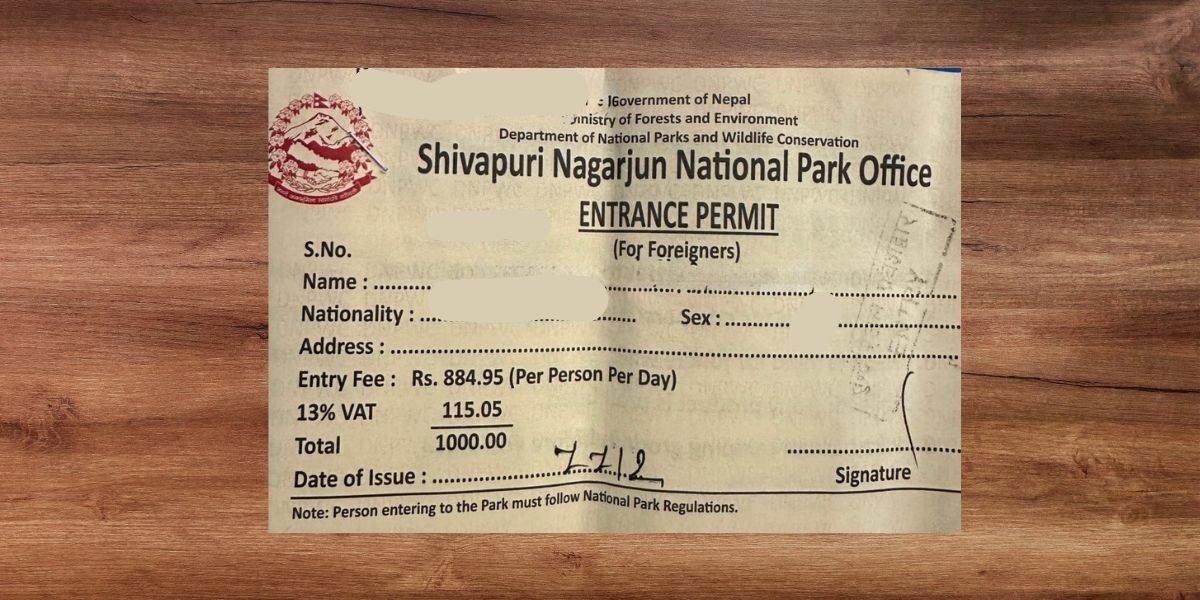
In Kathmandu, the issuing department is NTB. Many tourists often get their permit at the army checkpoint in Budhanilkantha, Sundarijal Gate, Tokha Gate (Baniyatar/Jhor), Kakani Gate, or Jhule Checkpoint.
And if you’re thinking of getting your permit online, Shivapuri National Park’s permit can be obtained through DNPWC’s website. All you need to do is sign up (using your passport number), select a permit type, and either choose Counter Payment Request or QR Payment. Be sure to print it and show it at the checkpoint!
The Shivapuri-Nagarjun National Park Entrance Permit costs are as follows:
- For Foreign Nationals: NPR 1000
- For SAARC Nationals: NPR 600
- For Nepalese: NPR 100
Gaurishankar Conservation Area Entrance Permit
Managed by the National Trust for Nature Conservation (NTNC), Gaursankhar Conservation Area is known for its rich biodiversity and its close proximity to Kathmandu.
In order to obtain the permit, you can either visit NTNC’s Online Portal and apply for it online, or you can visit NTB’s office in Kathmandu.
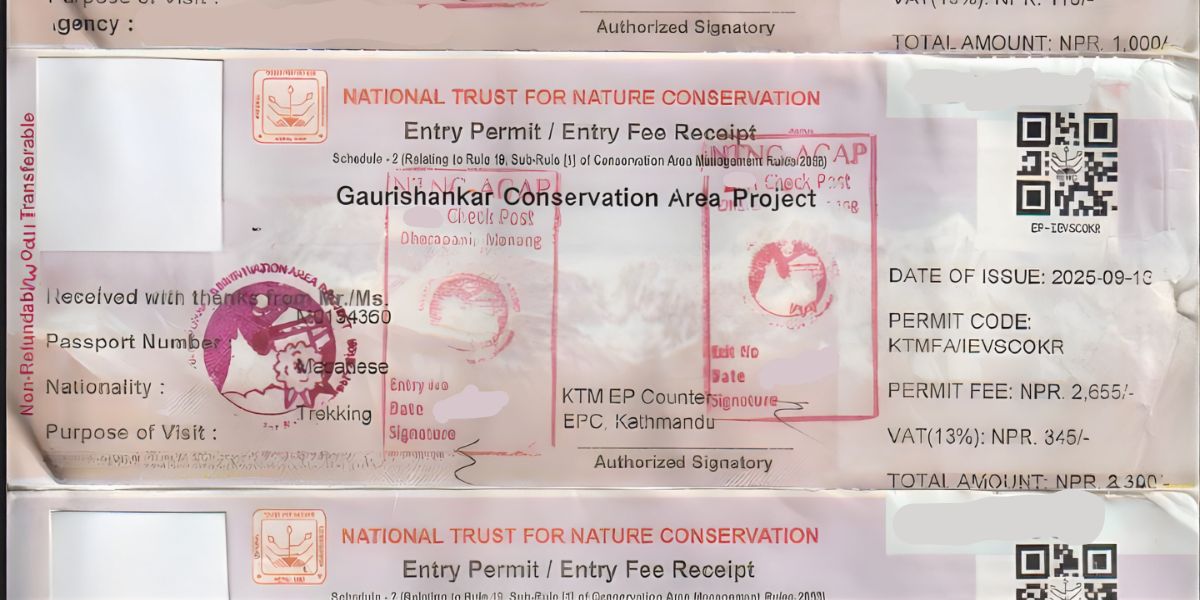
When it comes to conservation areas, visitors are highly recommended to apply for the permit before they reach the protected area. This is because the cost of the entry permit is doubled at the entry point!
While paying for the entry permits online, you must enter all the details related to your travel ID (passport, Aadhaar card, etc.), your contact information, and the details of your guides and porters. You can link your bank’s payment card to make the payment online.
Please remember that the permits are only valid for single entry!
Here are the pricing details for Gaurishankar Conservation Area Entrance Permit:
- Foreigners: NPR 3000
- SAARC: NPR 1000
- Nepalese: NPR 100
TIMS Card
With joint efforts from Nepal Tourism Board (NTB) and Trekking Agencies’ Association of Nepal (TAAN), Nepal introduced the Trekkers’ Information Management System (TIMS) Card in 2008.
It is true that a TIMS Card may make you feel like your exploration is restricted, as it strictly restricts you to pre-approved checkpoint trails and enforces a licensed guide, ultimately preventing you from spontaneously wandering onto uncharted side routes.
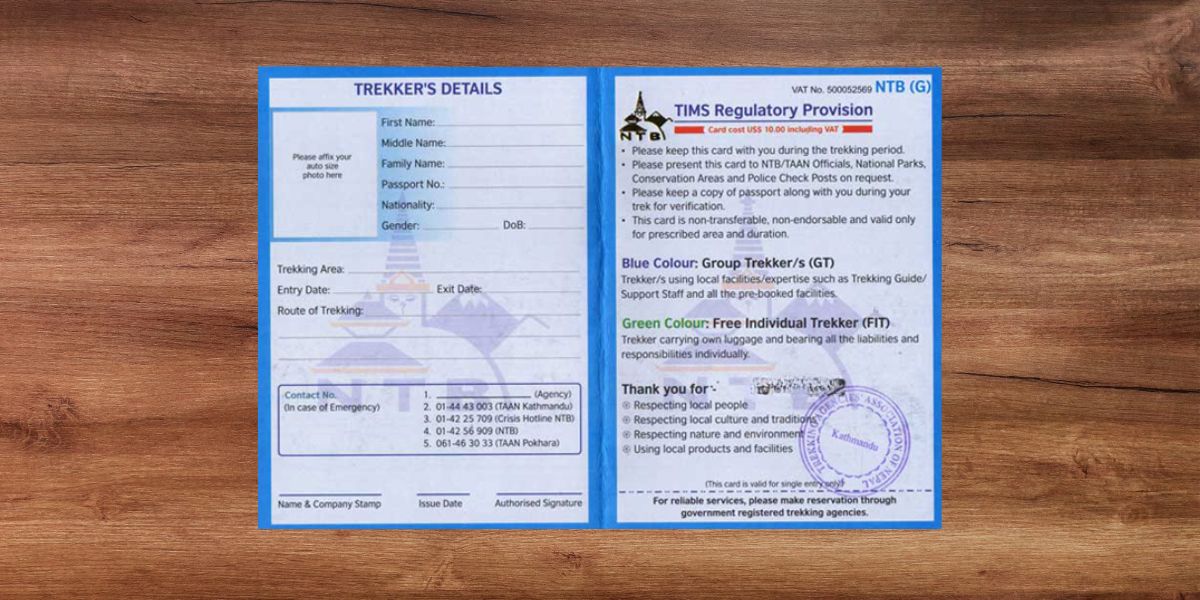
But this system was implemented to prioritize trekkers’ safety. Take it from us when we say that going off trail to explore on any given trekking trail is a big no, since you never know what trouble might pop up!
And once your details enter the database, they will be used in case of accidents and natural disasters.
The departments related to evacuation and rescue services will be able to track your location, making the process faster and reducing risks.
TIMS Card is needed for both Free Individual Trekkers (FIT) and those trekking in a group. But in the past few years, the TIMS card has become optional and isn’t compulsorily required.
Please look at the table below to find the details for the TIMS Card:
|
Nationality
|
Category (FIT or Group)
|
Cost (per person)
|
|
Foreigners
|
Group - Blue TIMS Card
|
NPR 1000
|
|
FIT - Green TIMS Card
|
NPR 2000
|
|
SAARC Nationals
|
Group
|
NPR 300
|
|
FIT (Free Individual Trekkers)
|
NPR 600
|
Table 2: Cost for TIMS Card based on nationality and category.
In order to register for a TIMS Card, trekkers must provide details such as their passport number, contact address, and trekking itinerary. If you are looking to apply for it, you have to reach out to a registered trekking agency (like us) to apply on your behalf!
Restricted Area Permit (RAP)
In Nepal, restricted areas are declared according to cases such as geopolitical, cultural, and ecological sensitivity. Most of the restricted areas here also share borders with Tibet.
While Langtang National Park does not have any restricted areas in its vicinity, Rasuwa district is home to some restricted areas. In particular, Gosainkunda Ward. 1 and a few parts of Gosainkunda Ward. 2 have been regarded as “restricted”.
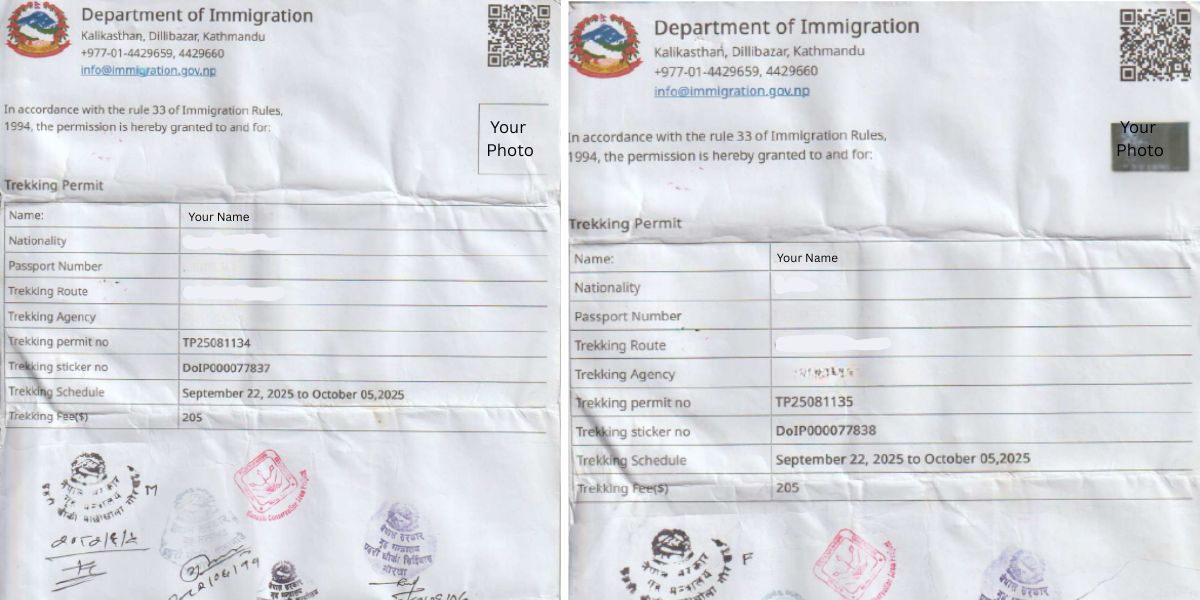
So what happens if you are trekking through restricted areas? First things first, FITs are not allowed here. So even if you are going alone, you must be accompanied by a licensed trekking guide at all times. The maximum number of members in a group is 7.
Now things can get a little tricky here. For those doing the Tamang Heritage Trek, only Thuman is listed as a Restricted Area, and it is very important that you bring the Restricted Area permit to enter here!
Each restricted area has a different price for RAP, and for this part of Rasuwa, it is USD 20 per person per week (for all non-Nepali visitors).
Applying for RAP
In order to issue a RAP, you must reach out to a licensed trekking agency that will do it for you. You and your group members must provide them with a copy of your passport and a valid visa showing you have sufficient days required to complete the trek.
In our Tamang Heritage packages, we have included them to comply with the rules set by the Department of Immigration.
Also, make sure that your agency has provided personal accident insurance for your trekking guide, porters, and other trekking crew.
Note: Once you get the RAP, just ensure that you stick to your itinerary and do not deviate to trails not mentioned in itinerary. Respect the people and the biodiversity you find, and respect the rules imposed by the authorised personnel of the restricted zones.
Peak Climbing and Expedition Permits in Langtang Region
If you have made it this far, then I am sure that you already have an idea that the permit system in Nepal is layered. This means that different authorities are assigned to issue permits for different sites and activities.
So if you are looking for a more adventurous time in Nepal and want to experience something beyond trekking, then you can go mountaineering. And even for mountaineering, there are different types of permits that fall under the jurisdiction of different authorities.
In simple terms, we have divided Nepal’s mountaineering permits in the following ways:
|
Category
|
Description
|
Peaks
|
|
Langtang Range
|
Jugal Range
|
|
7501 m - 7999 m
|
There are no Langtang or Jugal mountains within this category (as the highest peak is Langtang Lirung at 7,234 m).
|
N/A
|
|
7001 m - 7500 m
|
Only two mountains from the Langtang range fall in this category. You require a Liaison Officer in order to attempt the climb to these mountains.
|
Langtang Lirung (7,234 m), Langtang Ri (7,205 m)
|
N/A
|
|
NMA Group A
|
The mountains listed in this group are highly technical and expedition-style. While undertaking the mountains in this group, one must feel entirely comfortable with technical rappelling, anchor placements, and navigating raw avalanche chutes. The mountains in this group have vertical rock headwalls and intense ice flutings that demand extensive multi-pitch mixed climbing. No Liaison Officer is required, though.
|
Yubra Himal (6,048 m)
|
Langshisha Ri (6,412 m)
|
|
NMA Group B
|
The mountains listed in this group are non-technical to semi-technical. This group mountains are called “Trekking Peaks” as they are widely accessible to physically fit individuals who have basic knowledge of alpine gear. The routes mostly go through a glaciated slope without vertical rock technicalities. Also, climbers mostly have to use a single ascender on a pre-established fixed line to achieve the summit. No Liaison Officer is required.
|
Yala Peak (5,732 m) and Yala Peak South (5,520 m) - no mountaineering fee required, only NMA garbage deposits
|
Ghanja La Chuli (5,863 m)
|
|
Non-NMA (6501 m - 6999 m)
|
Remote peaks handled by the Department of Tourism. A Liaison Officer is required.
|
Pem Thang Karpo Ri (6,865 m), Salbachum (6,707 m), Pangri Goldumba (6,620 m), Kyunga Ri I (6,599 m), Dhagpache (6,575 m), Ghenye Liru (6,571 m), Kyunga Ri II (6,506 m)
|
Leonpo Gang (6,979 m), Dorje Lyakpa (6,966 m), Gurkarpo Ri (6,891 m), Bhairab Takura (6,799 m), Leonpo Gang East (6,733 m), Phurbi Chyachu (6,631 m), Yangri (6,535 m)
|
|
Non-NMA (Less than 6500 m)
|
Handled by the Department of Tourism because they are in highly remote, border-restricted regions. Doesn’t require a Liaison Officer.
|
Thakmorpa Ri (6,185 m), Peri (6,174 m), Bhemdang Ri (6,150 m), Thakmorpa North East (5,966 m)
|
Ganchenpo (6,378 m), Gyalzen Peak (6,151 m), Urkenmang (6,150 m), Baden Powell Scout Peak (5,857 m)
|
Table 3: Classification of mountaineering permits
Expedition Permits
Expedition permits are required for those trying to summit peaks in the Langtang region that are over 7,000 m, which are Langtang Ri (7,205 m) and Langtang Lirung (7,234 m).
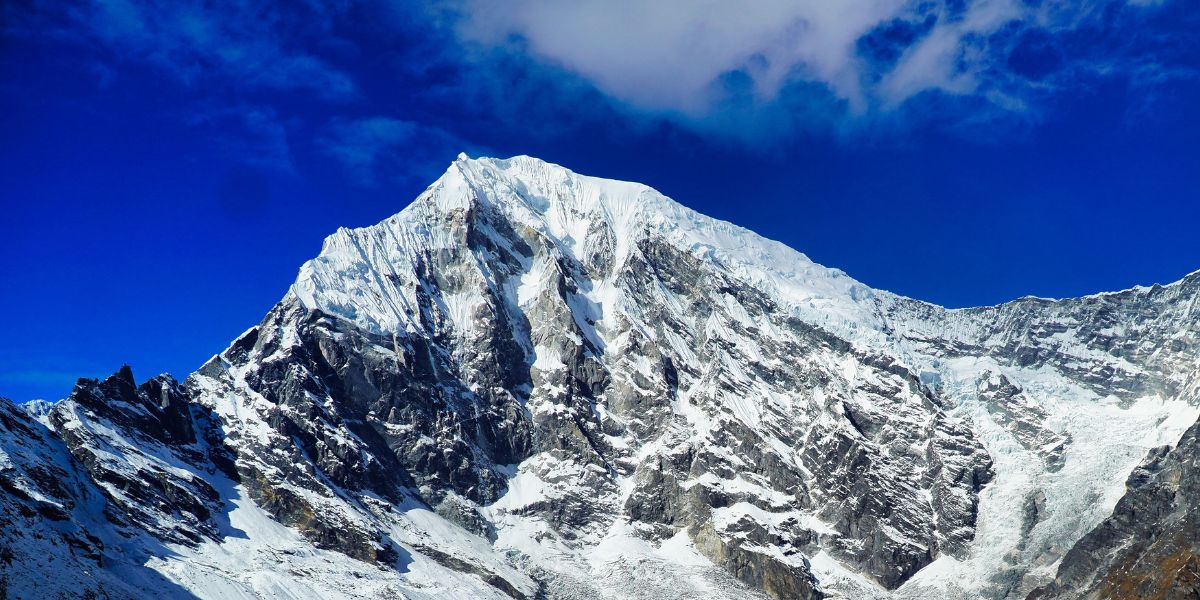
Given that expeditions to the Langtang and Jugal mountains come with greater risks, the authority to issue the permit is governed by the Tourism Department under the Nepal Government. In order to obtain the permit, individuals have to pay a high amount of royalty, and the prices vary according to season.
Please look at the table below to find the updated royalty fees for expedition permits required for mountains in the Langtang Region. Since both mountains fall in the range of 7,001m to 7,500m, the royalty amount is the same:
|
Nationality
|
Spring
|
Autumn
|
Winter and Summer
|
|
Foreigners
|
USD 800
|
USD 400
|
USD 200
|
|
Nepalese
|
NPR 30,000
|
NPR 15,000
|
NPR 7,500
|
Table 4: Royalty fees according to season for foreigners and Nepalese
Garbage Management System
If you have been expressing your interest in expeditions for a while now, then you have probably heard of the garbage management crisis in the Himalayas. For this reason, the Ministry of Culture, Tourism, and Civil Aviation has introduced a new rule for garbage management.
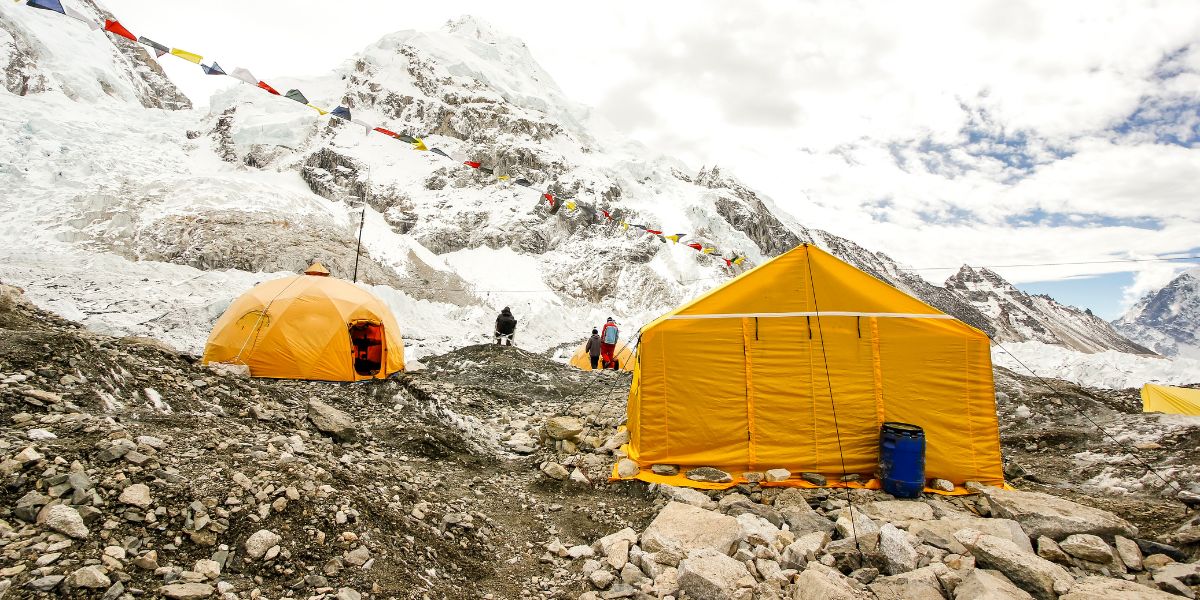
For those attempting the summit of Langtang Ri and Langtang Lirung, expeditioners now have to deposit an amount of USD 500 before they start the trek.
The deposit is refundable under the condition that you bring back your waste to the LPCC (Langtang Pollution Control Committee) site in Mundu or Kyanjin Gompa along with official clearance paperwork from your peak climbing agency.
Note: LPCC handles waste management on a much smaller financial scale than SPCC in the Everest region; LPCC works locally!
The process of getting the refund involves:
- The expedition leader must formally submit an application to the Department of Tourism (DoT).
- You must attach a Garbage Management Report signed by the team leader, the trekking agency, and the officially assigned Liaison Officer.
- You must provide a verification/recommendation letter from the designated local authority confirming the waste was managed.
- Once you submit the waste there, you will receive a Garbage Clearance Certificate, and only then will you be refunded the same amount. Failure to do so will result in forfeiture of the amount deposited.
How to Apply for the Expedition Permit?
There is no way that you will be going on the expedition alone, and as per the rules, you must always be accompanied by a licensed guide. So, before you even apply for the permit, do thorough research on the trekking/mountaineering agency you want to choose for this experience.
Mountaineering is not an easy activity, so make sure that the agency you go for has good reviews and has been in the game for a considerable time. Some of the basic documents required are your passport copy, recent passport-size picture, itinerary, a valid visa, and contact details.
Additionally, for 7k peaks, you must have proper travel insurance that covers high-altitude emergencies, rescue and evacuation services that are done by a helicopter, death repatriation, and a medical report stating you are fit for the expedition.
Your overall health and rescue insurance should be worth USD 30,000 (minimum). Do not forget to include the invoice for the garbage management deposit, and the agency will apply for the permit on your behalf.
Trekking Peak Permits
If you want to climb peaks (below 7,000 m), then firstly, you need to know about the Nepal Mountaineering Association (NMA).
NMA is a non-governmental body that was established in 1973. It has the authority to issue climbing permits for 27 peaks in Nepal.
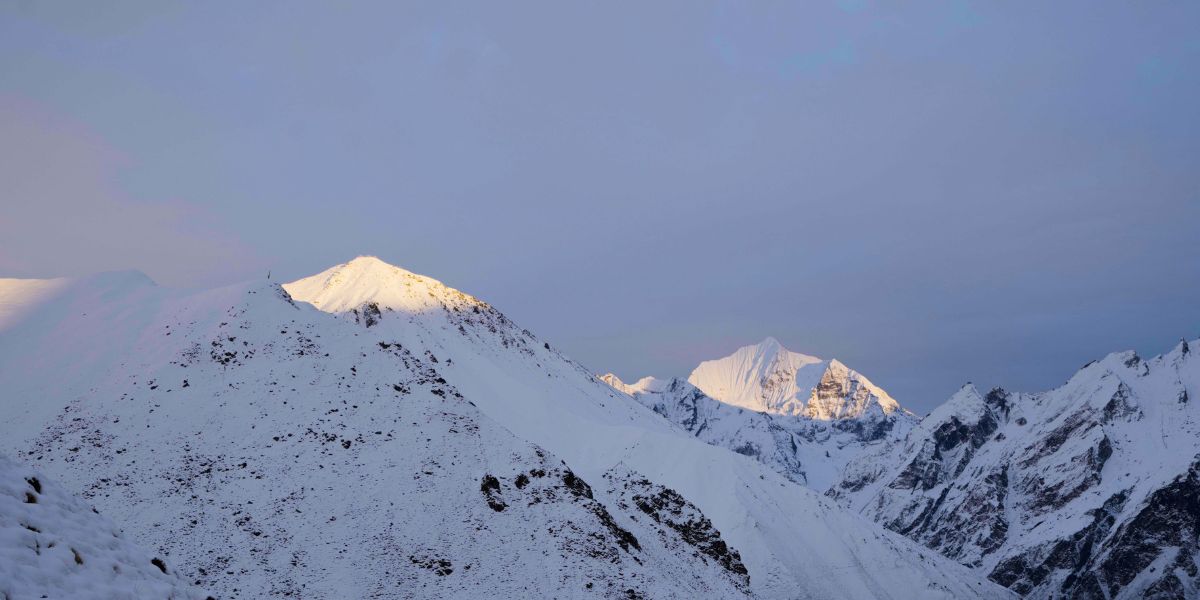
The organization makes trekking and mountaineering accessible to people, and they have divided these peaks into two categories:
- 12 peaks fall under Group A Peaks. Peaks that fall under Group A require more experience and are known for being technically difficult.
- The remaining 15 peaks fall under Group B Peaks and welcome trekkers who are physically ready to summit moderately difficult peaks.
- Also, there are 6 more peaks that it oversees for which you won’t have to pay the permit fee, among which one is Yala.
Once again, the royalty fees vary according to the season and nationality.
Please look at the tables provided below for more details on the peaks from the Langtang region that fall under the two categories of NMA:
|
Groups
|
Peaks
|
Range
|
Spring
|
Autumn
|
Winter and Summer
|
|
A
|
Langshisha Ri
|
Jugal Himal
|
USD 350
|
USD 175
|
USD 175
|
|
A
|
Yubra Himal
|
Langtang Himal
|
USD 350
|
USD 175
|
USD 175
|
|
B
|
Ghanja La Chuli
|
Langtang Himal
|
USD 350
|
USD 175
|
USD 175
|
Table 5: Group A and Group B Langtang peaks of NMA along with their royalty fees for foreigners.
For Nepalese climbers, the royalty fees are different. Please find them in the table below with other details:
|
Groups
|
Peaks
|
Range
|
Spring
|
Autumn
|
Winter and Summer
|
|
A
|
Langshisha Ri
|
Jugal Himal
|
NPR 20,000
|
NPR 10,000
|
NPR 5,000
|
|
A
|
Yubra Himal
|
Langtang Himal
|
NPR 20,000
|
NPR 10,000
|
NPR 5,000
|
|
B
|
Ghanja La Chuli
|
Langtang Himal
|
NPR 20,000
|
NPR 10,000
|
NPR 5,000
|
Table 6: Group A and Group B peaks of NMA along with their royalty fees for Nepalese citizens.
What About Yala Peak and Yala Peak South?
You must be wondering about Yala Peak (5,732 m), the one gaining fame among beginner expeditioners. This beautiful peak of the Langtang Himal range is also one of the NMA peaks.
Yala Peak South (5,520m) is a popular trekking peak that lies south-east of the main Yala Peak. It is often climbed as an introductory Himalayan summit. On the contrary, the main Yala Peak is also accessible, but only a few trekkers reach it!
As of 2026, Yala Peak comes under the group of 6 NMA Peaks, for which climbers do not have to pay royalty fees in order to summit. However, the garbage management deposit is still applicable. Continue reading to learn more about it!
Garbage Management Fees for NMA Peaks
If you have read the section regarding expedition permits thoroughly, you must be aware that garbage management deposits are mandatory. It is the same for treks to NMA peaks as well, no matter which group of peaks you are aiming for.
The Garbage Management Fee is priced at USD 500. The conditions are the same; the amount is refundable, except that the garbage should be returned to the authorized local body.
Upon receiving the Garbage Clearance Certificate, you can expect the deposit to be refunded. You should also present a Garbage Transfer Application from your agency along with the original receipt of the deposit given to you by NMA. Failure to do so will result in the forfeiture of the deposit by NMA.
How to Apply for a Trekking Peak Permit from NMA?
For both Group A and Group B mountains, no liaison officer is required.
The basic documents required are the same as those needed for expedition permits: a copy of your passport, a recently taken passport-size photo, a valid visa, itinerary, and contact information.
Apart from that, both Nepalese and foreign trekkers must have accident insurance worth NPR 20 Lakhs, medical insurance of at least NPR 4 Lakhs, and helicopter rescue insurance worth USD 10,000.
As you can guess, FITs are strictly forbidden, and your group can have a maximum of 15 members. Lastly, make sure to present the receipt of your Garbage Management deposit, and your agency will handle the rest of the application process.
Special Activity Permits in Langtang
If you are planning to explore Langtang and its attractions for purposes other than an adventurous experience, then please keep in mind that such purposes also require separate permits.
I am talking about activities like professional filming or photoshoots, camping, helicopter tours, and research. So, read this section carefully if you want to learn how you can obtain permits for such special activities.
Permits for Professional Filming
When it comes to professional filming in Nepal, your permit is issued by the Ministry of Communication and Information Technology (MoCIT). But that is only after you receive consent from the related authorities of the locations where you plan on shooting.
So let me walk you step by step:
- First of all, you will need a local coordinator to communicate your filmmaking purpose to the MoCIT. In this case this can be the trekking agency you are going on a trek or expedition with. The best option is to choose a trekking agency, as they can also help you with trekking guides, other permits associated with the trek or expedition, and managing the logistics.
- Write a letter of authorization stating that you have appointed the agency as your local coordinator. The letter should also include details regarding your project along with the duration of your stay; these details will help you obtain the visa and local shooting permits. Please note that once you submit the letter, your local coordinator will have the authority to represent you during official tasks.
- Do not forget to add a Rs. 50 Nepali postal stamp on your application form.
- You will also need to provide additional supporting documents. Depending on the type of your project, you will have to provide a script, storyboard, or synopsis. These documents play an important role in ensuring that you receive the filming permit.
- And lastly, you will have to provide the details of your crew members, the itinerary of the shoot, and the list of equipment. For crew member details, include their names, passports, their positions for the shoot, and their profile. Also include each member’s date of arrival. In the itinerary, include the locations where you will be shooting (Google site map) along with the days and dates you will be staying there for the shoot. Make sure to mention the value of each piece of equipment on the equipment list. This is required for customs clearance once you land in Nepal.
The steps mentioned above are the initial process. Since this blog has been written specifically for trekking and expeditions in Langtang Region, let’s look into the details regarding the consent letters you will have to present to MoCIT.
- While filming in Langtang National Park, you must include the consent letter from the Department of National Parks and Wildlife Conservation (DNPWC). Additionally, the fees are as follows for filmmakers from different nationalities:
|
Nationality of the Filmmaker/Production Company
|
Fee/Charge
|
|
Foreigners
|
USD 1,500
|
|
SAARC
|
NPR 50,000
|
|
Nepalese
|
NPR 10,000
|
Table 7: Fees for shooting in Langtang National Park. Also, applicable for Shivapuri National Park.
Note: For aerial filming, you will have to pay an additional 25% charge. More information on drone filming has been covered in the following subsection.
- While filming in Gaurisankhar Conservation Area, you will need to present the consent letter from NTNC.
- While filming in Thuman (Tamang Heritage Trail), make sure to obtain a consent letter from the Ministry of Home Affairs, as it falls within a Restricted Area.
Note: Individuals must pay 13% VAT as well as an additional 25% of the fee mentioned above (applicable to all nationalities).
Permits for Aerial (Drone) Filming
When it comes to aerial (drone) filming, the authorities who provide the permit are entirely different. Instead of the Film Development Board, the leading bodies in this case are the Civil Aviation Authority of Nepal (CAAN), Ministry of Home Affairs (MoHA), and Ministry of Defence (MoD).
But before we move forward, let me tell you some details about classifications of drones by CAAN. Classifications depend on the maximum take-off weight of the drone:
|
Classifications
|
Maximum Take-Off Weight
|
|
Category A - Very Low Risk Operations
|
Less than or up to 250 gm
|
|
Category B - Low Risk Operations
|
250 gm to 2 kg
|
|
Category C - Regulated, Low Risk Operations
|
2 kg to 25 kg
|
|
Category D - Regulated, High Risk Operations
|
More than 25 kg
|
Table 8: Classifications of Drones based on maximum take-off weight.
The official rules of Film Development Board (FDB) and the Ministry of Communication and Information Technology (MoCIT) state that the legal way to operate drones in restricted areas is as follows:
- Firstly, any aerial or drone filming should be done with standard permission from the Civil Aviation Authority of Nepal (CAAN) and Ministry of Home Affairs.
- Another thing: if your itinerary crosses into the mentioned restricted areas, then you will require a consent letter from the Ministry of Home Affairs along with a specialized location fee that needs to be paid at the rural municipality.
- Lastly, a special operational permission must also be approved by the Ministry of Defence, as these places sit directly along sensitive international border zones.
Now, let’s look into the process of registering your drone at the CAAN:
- Fill out CAAN’s application form for drone registration in order to receive the Unique Identification Number (UIN). You should also submit the Purpose of Operation and Letter of Commitment. Forms and formats for the letters have been provided on CAAN’s official website.
- Along with the documents mentioned above, you must include a recently taken color passport-sized photo, drone pictures where the serial number is visible, a copy of your passport with a valid Nepal visa, and the drone's customs declaration from Tribhuvan International Airport (TIA). Please note that the registration fee is USD 50 with 13% VAT.
- If your drone is classified as Category C or D, then you must have valid insurance for the drone. You must also present it at the Flight Safety Standards Department (FSSD) at CAAN for physical verification during registration.
- Once you complete the formalities with CAAN, you will need to obtain another permit from the DNPWC.
- Once you receive the permit from DNPWC, you will need another permit from the Department of Tourism. Foreigners must pay NRs 15,000 to issue the permit. As for Nepali nationals, they will have to pay NRs 12,500.
- Lastly, make sure you also have the permit from the Chief District Officer (CDO). This means your application also needs to be reviewed by the MoCIT and the MoHA. For drones of Category C and Category D, you must obtain a clearance from MoHA.
The process to obtain all the permits can take longer than a month. So if you are a foreign national, make sure that you start the process at least 3 months prior to the date of the shoot.
Additionally, obtaining permits for Nepalese nationals is faster and even more affordable. So if that suits you, why not choose convenience?
I understand that reading these processes online can feel confusing. So, feel free to reach out to our team at Altitude Himalaya if you require more clarity. Our team also includes professional filmmakers and local fixers who can make the entire experience smoother without hindering your creative progress!
Travel Insurance Requirements
While the travel insurance requirements for expeditions have already been covered under the related section above, let’s look into the travel insurance that you need for trekking in Nepal.
Although trekking in the Langtang Region does not take you to high-altitude regions that peak climbing and expeditions do, 5,000 m is still high and risky enough for you to get insurance.
Here are the two main factors that your travel insurance must cover:
Emergency Medical Insurance
Injuries and accidents are predictable while trekking. But do you know what is more common and equally dangerous? Altitude Sickness!
And in the remote areas of Langtang National Park, getting timely medical help is a huge privilege. Because they don’t have hospitals. They have the most basic health posts that are located miles away from each other. And with logistical difficulties, reaching health posts itself is a challenge.

So what services should you expect from your travel insurance if you are trekking in Langtang National Park? First things first, make sure that your insurance provides coverage for medical services required for high-risk activities.
Also, check if your insurance provider has reliable resources in Nepal. This means that they should be able to arrange hospitals as well as direct payments. Furthermore, they should provide assistance 24/7 because you never know when medical emergencies occur.
And apart from covering expenses for your hospital stays, medical evacuation (usually done via helicopter), prescriptions, and doctor visits, your insurance provider should also offer repatriation to your home country.
Trip Cancellation or Interruption
For most people, cancelling a trip that has been planned for months is already a devastating feeling. But not receiving the refund for flights and other bookings? That would be an even more bitter experience.
And people generally do not cancel their trips unless they really have to. So make sure that your travel insurance provider reimburses you for expenses in cases of illness, injury, and unforeseen emergencies like a sudden layover or death in the family.
While some conditions might not be covered, try getting insurance that considers factors like pregnancy, geopolitical tensions, terrorist attacks, and natural disasters at your destination. Please note that some insurance providers do not cover emergencies that arise out of pre-existing health conditions.
While trip cancellation is one thing, interruption is another. And if you are trekking, your buffer days might extend longer than expected (common in the Himalayas due to unpredictable weather).
So, make sure that your insurance provider is prepared for these events. In cases of cancellation and interruption, you might not get 100% reimbursement, but even 50% can make you feel relieved.
The two factors mentioned above are a must when it comes to travel insurance. But here are some other factors that you can consider while getting travel insurance:
- Loss of baggage or personal belongings
- Damage to a vehicle rented abroad
- Trip Cancellation or Interruption
- Telephone Medical Advice
- Max altitude coverage
Permit Checkpoints Along Langtang Routes
If you have read the topic on TIMS Card, then you probably know that the bureaus related to checking permits are not as consistent as they should be, but progress is still being made.
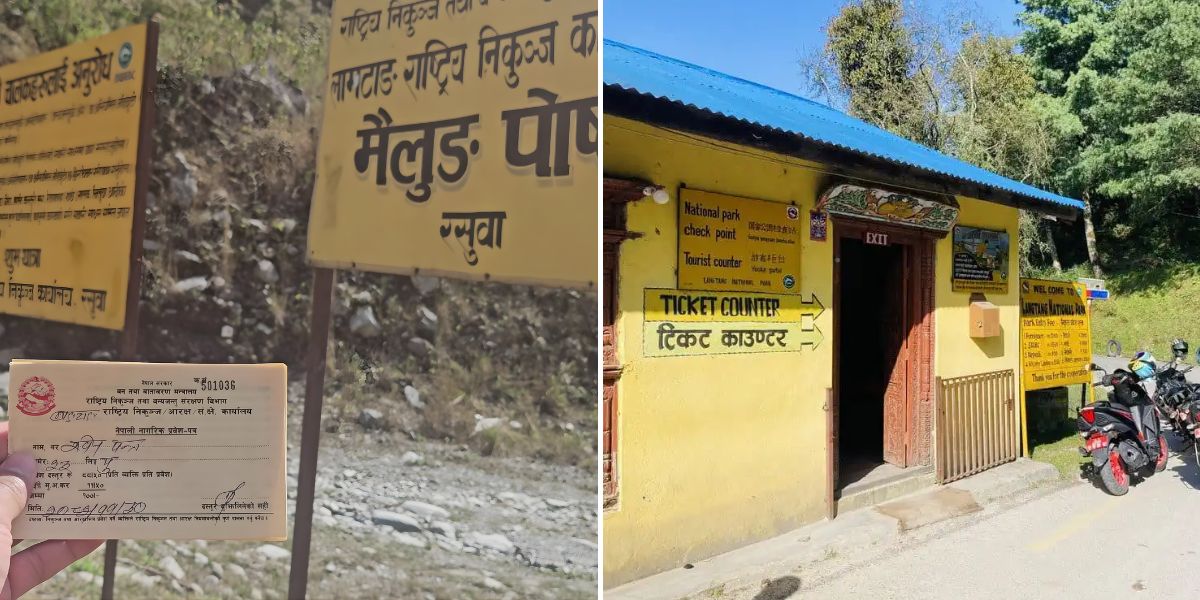
That being said, the conditions are similar when it comes to checking permits. However, to keep you informed, here are the areas that fall within the trails of Langtang National Park where permit checkpoints are located.
- Dhunche (1,960 m): Dhunche is one of the most common points taken by trekkers to enter Langtang National Park. They do not have a designated office, but the Army Checkpost is where you can get the permit.
- Ghoda Tabela (3,008 m): If you are doing the Langtang Valley Trek, then you will find a checkpoint at Ghoda Tabela. When you’re here, all you have to do is show your permit, list yours along with the names of other members in your group. If you are travelling with a guide, then they will do everything for you. For emergency purposes, you will have to provide the phone number of one of the team members.
- Cholangpati (3,584 m): For those doing the Gosain Kunda Trek, they can find a checkpoint at Cholangpati. The same process as Ghoda Tabela is followed here, where you give your name and your group members’ names along with a phone number. You will find the checkpoint the moment you reach the settlement of Cholangpati, where teahouses are available.
- Tarkeghyang (2,600 m): If you are ending your Gosainkunda Trek at Sundarijal or doing the Helambu Circuit Trek, then your National Park Permit will be checked at Tarkeghyang. Those interested can also do the Naya Kanga Peak climb via this route. Apart from the checkpost, you can also find a small police station and lodges nearby.
- Mangengoth (3,420 m): While doing the Helambu Circuit Trek, your permit will be checked at Mangengoth. Mangengoth also serves as an important stop for those doing the Gosainkunda Trek from Sundarijal.
- Kutumsang (2,470 m): This checkpoint serves as a very important doorway on the southern side of Langtang National Park for trekkers who are doing the Helambu Circuit and Gosainkunda treks.
Note: There were checkpoints in Mailung and Syaphru Bensi too, but sadly, both were swept away by the August 2026 flood. We are currently unsure whether these checkpoints will be recovered anytime soon.
While the national park checkpoints in the places mentioned above are mainly set to check trekkers’ permits for Langtang National Park, if you are trekking via Shivapuri National Park or Gaursankhar Conservation Area, then be prepared to find more checkpoints along the way!
For this reason, you must always keep your permits safe and in an easily accessible part of your bag. Make sure that you do not lose them, or even better, you can just give them to your guide, who will keep them safe for you.
Apart from the regional checkpoints set by the DNPWC, you will also come across Army Checkpoints at multiple stops along the way. While the army has the authority to issue the permits, they are also there for a whole different reason.
Nepal’s national parks and conservation areas are home to some of the rarest biodiversity. In the past, there have been records of many illegal activities related to poaching and smuggling.
So the army checkpoints are placed there to ensure that no one has taken any rare flora, fauna, or other forest items. It is very important that you comply with them when they ask to inspect your belongings. Don’t worry, it generally won’t take longer than 10 minutes.
Apart from that, your filming and drone permits are also checked at the army checkpoints and national park offices. So make sure to present all the documents and clearance permits, and you won’t face any issues during the shoot.
Important Permit Rules and Regulations You Should Know
Almost every important detail has been covered in the sections above. So this section has been written just to remind you of the rules and regulations regarding different permits that you must know. Read it carefully to avoid mistakes that many trekkers make:

Regarding Trekking and Expedition Permits
By now, you must be well aware that trekking permits and expedition permits have totally different processes for obtaining them, and this section is here to introduce you to further rules and regulations. So, go through it carefully:
- Your entry permits for national parks and conservation areas are not the equivalent of the TIMS Card. So make sure to carry each of them.
- TIMS Card is not checked consistently throughout the trail, but getting it is for your own safety. Your data will be stored in the related department’s database, making them alert for evacuation in case of emergencies.
- This has already been mentioned above, but if you are crossing two national parks or conservation areas while covering a single trail, you will need entry permits for all of them separately.
- The rates of permits vary according to nationality. So make sure you pay for your respective identity. Discrepancies will be checked at army checkpoints, and if you are caught, that will not be tolerated by the authorities.
- Always hire a licensed guide for trails where FITs are forbidden. Even if you are an experienced trekker, rules apply for everyone regardless of their experience.
- While trekking in restricted areas, do not explore outside the trail mentioned in your itinerary. If caught, you will be met with consequences. Rules have been set with respect to border and environmental sensitivity.
- If you plan on getting your entry permit for the conservation area at the entry point, you will have to pay double the actual price. So make sure you get it in Kathmandu or other places where the respective conservation area falls under.
- Children below the age of 10 are exempt from entry permits, but they must be accompanied by responsible adults who are related to them.
- Always stick to the rules that have been provided by the officials. They are for your own well-being and to ensure that you have a smooth experience.
- Make sure that your entry permits are safe and with you at all times. Do not leave them behind at teahouses or stops you make. Carry them responsibly; losing them might result in problems that are totally avoidable.
Regarding Professional Filming and Aerial (Drone) Shooting
There are separate rules and regulations for filming and aerial (drone) shooting, and we have listed them below. Please go through them carefully:
- Carry all the permits from all the departments throughout the trail. To make it easier, organize them properly so that you can present the right documents at the checkpoints.
- Apply for filming permits and drone permits at least a month in advance. Since getting the permits is a lengthy process, make sure you have adequate time to apply before the shoot starts.
- Shoot permits are priced at a higher rate for foreign filmmakers and production houses. It is always better and recommended to work with a well-reputed production house from Nepal. In fact, you can receive the permits faster through them.
- Always choose a well-reputed and locally trusted agency like us to be your local coordinator to represent you in front of the government bodies while getting these permits.
- Remember that drone permits are only given to those above the age of 18. Additionally, the drone operator must be well-versed in the equipment, radio frequency, and flight control.
- Your drone should not go outside the Google site map that you have presented to the authorities.
- Furthermore, drone operation is only allowed when there is daylight. Make sure that there is no rainfall, snowfall, hailstorm, and thundering during the time of flight.
Follow these tips, and you are good to go!
Final Words
This has been a lengthy blog, and a technical one, to be honest. But I do hope that I have provided all the details that will help you prepare for your trek or expedition.
The system is indeed inconsistent with checking, and many permits take time to arrive, but there is one message that Nepal is trying to convey. The message is clear and loud: The mountains are not free to use for anyone’s entertainment.
Managing it ecologically requires a large amount of resources. But the government is not only concerned with management. It is also concerned with the safety and well-being of the visitors.
And this explains why the permit system is layered. If the DNPWC is concerned with the conservation and preservation of biodiversity, then the TAAN is concerned with record-keeping and visitor safety.
And in this manner, each department has been given different responsibilities to promote safe and sustainable tourism in the mountains.
In regions where roadways are a form of luxury, preserving nature is the best step that Nepal can take to maintain the uniqueness of the experience it has to offer.
So if Langtang National Park is on your bucket list, think of the permit fees as the least of the contribution that you can make for the environment and the people who safeguard it.


 Suraksha Subba