



Did you know that Langtang Lirung is one of the most studied glaciers in Himalayan science? According to multiple studies, Lirung Glacier in the Langtang Valley has recorded a surface lowering rate of 1.3 to 1.8 meters per year between 1974 and 2010, with thinning accelerating majorly after 2000!
This glacier has retreated over 900 meters in total horizontal distance since 1979, at an average of 40 meters per year. Well, this 8-Day Langtang Valley Trek gives you enough time to actually go up and see it (from different viewpoints and different angles).
It includes Kyanjin Ri (4,700 m) and Tsergo Ri (4,985 m), the two major viewpoint hikes of the Langtang region. And also adds a third option on Day 5: a full-day hike to either Langshisha Kharka (4,050 m) or Langtang Lirung Base Camp (4,407 m).
Like all our Langtang packages, this trek starts directly from Kathmandu city. No domestic flights, no advance coordination beyond arriving in Nepal and reaching out to our team. Here’s what happens:
- The day your guide picks you up from Kathmandu is Day 1. Your journey begins with a 110 km drive from Kathmandu to Syaphru Bensi or Syabrubesi (1,467 m), where you have lunch before starting the first 8 km trek to Bamboo (1,984 m).
- Day 2 covers 11 km to Thangshyap (3,140 m), gaining 1,160 m over 6 to 7 hours.
- Day 3 is the longest day: a 15 km push from Thangshyap to Kyanjin Gompa (3,890 m), reaching as high as 4,700 m with the Kyanjin Ri evening hike included.
- Day 4 starts before dawn with the full Tsergo Ri hike, a 10 km round trip to 4,985 m, followed by a free afternoon in Kyanjin.
- Day 5 is your choice between Langshisha Kharka (24 km round trip, 8 to 10 hours) and Langtang Lirung Base Camp (10 to 12 km round trip, 5 to 6 hours).
- Day 6 brings the long 18 km descent to Lama Hotel (2,515 m).
- Day 7 is a short final 11 km walk back to Syaphru Bensi with a full evening to rest.
- And Day 8 is the 110 km drive back to Kathmandu.
Read through the complete package before booking this package with us. The itinerary, trail conditions, accommodation details, difficulty breakdown, and preparation guide we have included below will surely give you a full picture of all eight days!
Who Should Choose This 8-Day Package?
This 8-day format of Langtang Valley Trek is the most flexible itinerary in terms of who it actually works for.
The extra day compared to the 7-day classic gives you something the other packages cannot: a third attraction of the Langtang region, along with the room to go at your own pace.
Also, this 8-day trek is the most season-proof option we offer:
- During spring and autumn, when weather conditions are favorable, you can realistically complete all three high-altitude hikes across Days 3, 4, and 5.
- In monsoon or early winter, when weather windows are unpredictable, the extra day means that even if Day 5 is lost to poor visibility or trail conditions, you still get to do Kyanjin Ri and Tsergo Ri.
Basically, at minimum, one viewpoint is almost always achievable even in the most difficult weather period.
So, this 8-Day Langtang Valley Trek is the right choice if:
- You want to experience every major attraction the Langtang region has to offer. Three high-altitude hike options, two nights in Kyanjin Gompa, a full evening in Syaphru Bensi (no driving back the same day), and not a single day that feels rushed.
- You are an absolute beginner who has never hiked before. With eight days, you can take the trek at the slowest comfortable pace, choose only one of the three Day 5 options, and come back with a genuinely complete Langtang experience.
- You are an adventure trekker who wants to push further. With Tsergo Ri on Day 4 and either Langshisha Kharka or Langtang Lirung Base Camp on Day 5, and the possibility of doing both if you are strong enough, this is the format that rewards experienced trekkers the most.
- You want to time your trek with the Langshisha Mela. This sacred annual festival of the Tamang community is celebrated at Langshisha Kharka during the full moon of Bhadra, which typically falls in August or September. The eight-day format gives you the flexibility to plan your Day 5 to coincide with the festival, which is one of the most genuine cultural experiences in the Langtang region.
- You want the best weather contingency. One extra day compared to the 7-day means that a single bad weather day does not compromise the core experience. Your guide will redistribute activities accordingly; just follow his/her lead.
Where You’ll Stop Along the Langtang Route
On this 8-day trek, your overnight stops are going to be at Bamboo, Thangshyap, Kyanjin Gompa (three nights), Lama Hotel, and Syaphru Bensi. Let’s learn about them more in this section.
Syaphru Bensi or Syabrubesi
Syaphru Bensi is the last proper town before Langtang National Park begins, sitting at the confluence of the Langtang Khola and the Bhote Koshi River at 1,467 m. Also, it functions as the central trade hub for all the villages and communities in the Rasuwa District.
The Tamang community has inhabited this valley since ancient times, and the town also served as a trading route with Tibet. In fact, even today, the same route is used for trading with mainland China and is also the main route to enter Tibet from Nepal for pilgrimage tours like Kailash Yatra and Lake Manasarovar.
Moreover, the area was a historically significant site used for a military engagement during the Sino-Nepalese War of 1792.
You’ll learn more about such interesting facts on this 8-day itinerary when stopping at Syaphru Bensi for lunch on Day 1 and when spending a full night here on Day 7 before the final drive home!
Bamboo
Bamboo (1,984 m) sits at the point where the valley trail enters its first dense forest section. The settlement takes its name from the bamboo groves that line the Langtang Khola on both sides of the trail here.
On this 8-day itinerary, you stay here on the night of Day 1 and pass through again on Day 7 on the descent.
The Bamboo section of the trail is also notable ecologically! A 2014 ethnomedicinal research study documented 46 medicinal plant species across 26 plant families being used by local communities.
So, expect to come across some of these plant species when passing through the lower forest zones between Syaphru Bensi and Bamboo and towards Lama Hotel.
Lama Hotel
Lama Hotel (2,515 m), originally called Changdam Village, sits inside a steep gorge right next to the Langtang Khola. This steep gorge positioning is also why mobile network is weakest here compared to any other stop on the trail.
On this 8-day itinerary, you pass through Lama Hotel for lunch on Day 2 and overnight here on Day 6 after the long descent from Kyanjin Gompa.
The lower altitude after five nights above 3,000 m makes the sleep quality here noticeably better than any previous night on the trail!
Thangshyap
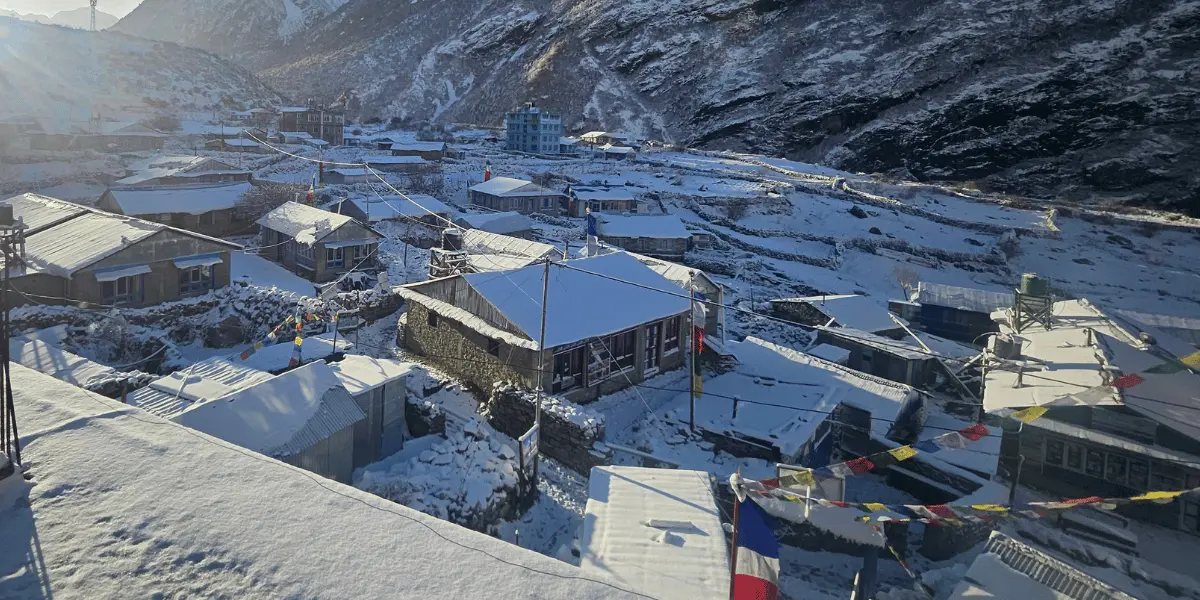
Thangshyap (3,140 m) is where the forest gives way to the first proper views of the high Langtang range above the treeline.
It is going to be your overnight stop on Day 2 on this itinerary, which spreads the elevation gain from Bamboo across two manageable days instead of one demanding push to Langtang Village directly.
Note that there are only a few teahouses here, which also means it is one of the quieter overnight stops on the trail. By stopping at Thangshyap rather than pushing straight to Langtang Village, your body gets enough rest and also gets to acclimatize well above 3,000 m.
Kyanjin Gompa
On this 8-day trip, you spend three nights in Kyanjin Gompa: Days 3, 4, and 5. That is the single most significant difference between this itinerary and other shorter itineraries!
Three nights here means you wake up with mountains on all four sides on all three mornings in a row (if the weather favors).
And on each of those days, you get to go in a completely different direction: Kyanjin Ri on Day 3, Tsergo Ri on Day 4, and the choice of Langshisha or Lirung Base Camp on Day 5.
You also have time for the Organic Yak Cheese Production Center, the Kyanjin Monastery, the Lirung Glacial Lake, and the afternoon village exploration that rushed itineraries always sacrifice.
Other Main Stops
Here are other major stops along the Langtang trek route:
- Domen (1,565 m): This is a small settlement where the forested valley trail begins, and you’ll stop for your first tea break!
- Pairo (1,722 m): Formerly home to a popular hot spring that was completely destroyed by a landslide. The hot spring no longer exists today, though the landscape around it still shows evidence of the old thermal site (ask more about it to the locals).
- Rimche (2,495 m): This is one small stop between Bamboo and Lama Hotel and also the place that leads you to Sherpagaun. Here, the rhododendron forest begins to thicken, so during spring, be ready to get mesmerized!
- Ghoda Tabela (3,008 m): It serves as a relay point for horses and mules. Today, there is a permit checkpoint, so you have to enter here before proceeding forward.
- Langtang Village (3,455 m): This is a rebuilt settlement that stands about a kilometer away from the original site that was buried by the 2015 earthquake avalanche. Over 300 people, including residents, guides, army personnel, and foreign trekkers, were killed! You’ll be passing through this avalanche zone and stop at the memorial to observe a moment of silence for the lost souls.
- Mundu (3,550 m): After leaving Langtang village, you’ll immediately come across another village called Mundu, where the alpine part of the upper Langtang truly begins. You’ll be passing along long mani walls and even get to stop for Sea Buckthorn juice, which will help you push forward.
- Sindhum (3,555 m): A short stretch above Mundu takes you to another Himalayan village of the Langtang region, which is right before your move to Kyanjin Gompa. From here onwards, you’ll get full views of the Langtang and Jugal ranges!
Major Attractions of This 8-Day Langtang Trek
What you will see on this trek ranges from the widest panorama in the region at Tsergo Ri to the most secluded high-altitude meadow at Langshisha Kharka, with the Lirung Glacier moraine and the cultural depth of the Tamang community in between.
Here are the major attractions on this 8-Day Langtang Valley Trek in detail:
Mountains, Glaciers, and Rivers
The mountains reveal themselves in different layers on this trek, and it starts from Syaphru Bensi itself. Here, you see majorly the valley and the first distant snowy ridges.
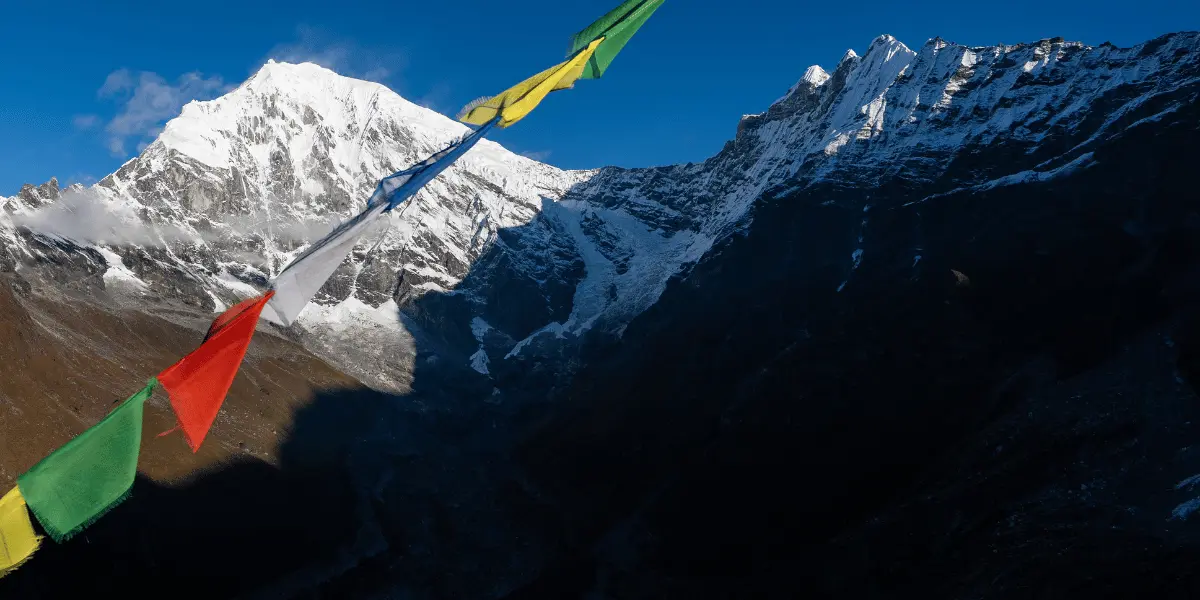
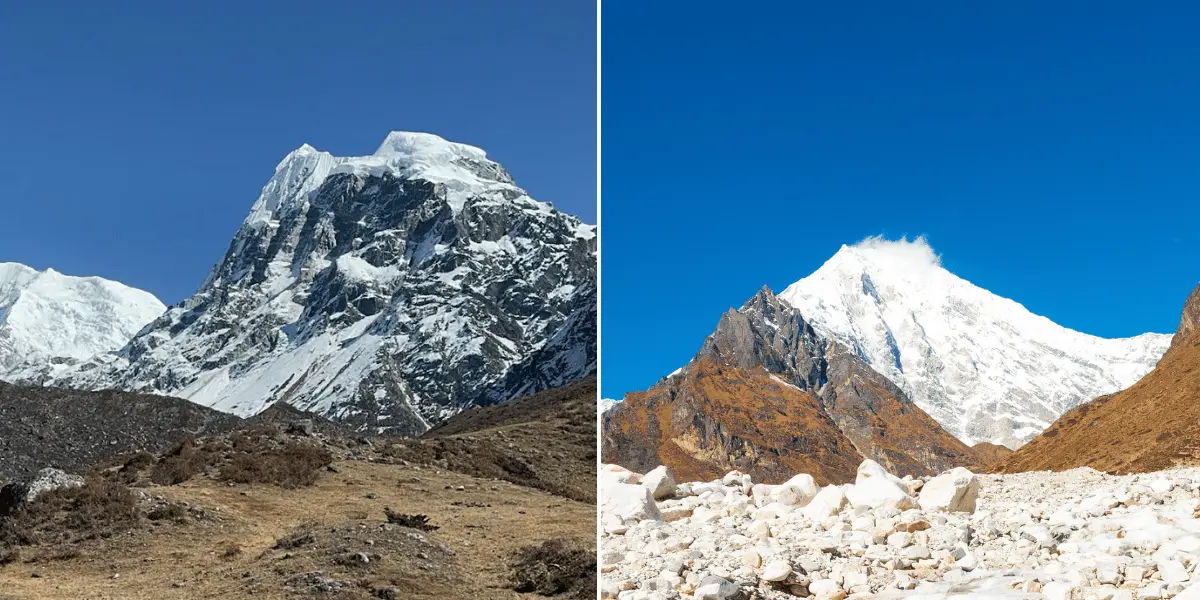
Then, as you gain altitude, the peaks begin to appear above the treeline: Langtang Lirung (7,234 m) becomes clearly visible from Lama Hotel for the first time!
By Langtang Village, the range has spread across three sides of the valley simultaneously, with Langtang II (6,571 m), Luri Himal (6,924 m), Pangshungtramo (5,262 m), and Boden-Powell South Peak (5,857 m) all visible.
Upon arriving at Kyanjin Gompa, Langtang valley fully opens, and mountains appear on all four sides: Ganchenpo (6,378 m), Pongen Dokpu (5,928 m), Tsergo Ri (4,985 m), and other parts of the Jugal Himal range.
The Lirung Glacier, which flows from the south face of Langtang Lirung, is the glacier you see from Kyanjin Ri, the Lirung Glacier viewpoint, and on the way to Langtang Lirung Base Camp.
And regarding the river system, the Langtang Khola stays beside you from Syaphru Bensi all the way to Kyanjin Gompa. This is a rivulet that joins the Bhote Koshi River at Syaphru Bensi, which is the same one coming from Tibet (where it’s called Kyirong Tsangpo) from the direction of the Tibet border.
Kyanjin Ri
Kyanjin Ri is one of the main viewpoints that makes the Langtang Valley trek one of the best treks in the overall region!
First, there’s the lower viewpoint (or Lower Kyanjin Ri), situated at an elevation of 4,300 m, and it can be reached via a 1.5 km steep climb (on mostly rocky terrain), taking about 1.5 hours.
The view of Langtang Lirung dominates the view directly in front of you, and the Lirung Glacier as well as the Lirung Glacial Lake can also be clearly seen from here.
The main summit of the Upper Kyanjin Ri is situated at 4,700 m, which adds a further 1 km and roughly one more hour of climbing.
This opens up a full 360-degree panorama of the Langtang and Jugal ranges, including Kimshung or Tsangbu Ri (6,781 m), Yubra Himal (6,048 m), Yansa Tsenji (6,567 m), Salbachum (6,707 m), Bhemdang Ri (6,150 m), and Yala Peak (5,732 m).
On this 8-day itinerary, Kyanjin Ri is planned for the sunset of Day 3. If the weather does not cooperate, the hike shifts to the early morning of Day 5 or 6, and the extra days provide the flexibility to wait for the right window.
Tsergo Ri
Tsergo Ri (4,985 m) is the highest point on this trek and the most demanding hike compared to all. The 10 km round trip starts at 3 to 4 AM on Day 4 and takes 7 to 8 hours in total.
Above 4,000 m, snow is indeed common throughout most of the year, so crampons are strongly recommended (along with leg gaiters).
The summit view adds peaks that were completely obstructed from other lower viewpoints: Ramthang Karpo Ri (6,865 m), Langshisa Ri (6,412 m), Gurkarpo Ri (6,891 m), Loenpo Gang (6,979 m), Dorje Lhakpa (6,966 m), Kanshurm (6,078 m), and Urkenmang (6,150 m).
Reaching Tsergo Ri gives you a great sense of achievement on this trail, and it is also the highest accessible viewpoint without requiring technical equipment!
Langshisha Kharka
Langshisha Kharka is honestly a hidden gem in the Langtang National Park. It’s basically a high alpine meadow at approximately 4,050 m, which is located northeast of Kyanjin Gompa and is roughly 12 km from the main village.
This 24 km round trip on Day 5 takes around 8 to 10 hours and comes with virtually minimal elevation change (only approx. 160 m gain), which means the challenge is the distance and the remoteness rather than the hike itself.
And please note that there are no teahouses along the route, so you have to get a packed lunch (which is what we promise to provide as a part of this 8-day package).
The meadow of Langshisha Kharka is used seasonally by yak herders, mainly during spring and summer. And the surrounding terrain is covered completely in alpine flowers during this time.
Also, the views from Langshisha Kharka come with the striking Langshisha Ri (6,412 m) in front and surrounding ridgelines. The area is genuinely remote, and only very few trekkers reach here compared to Kyanjin Ri or Tsergo Ri. This is exactly what makes this Langtang trek the most secluded experience on this entire itinerary!
One worth nothing is the Lang Shisha Mela, which happens to be a sacred annual festival celebrated at this exact location once a year during the full moon of Bhadra (August or September).
What happens in this festival is that the Tamang community of the upper Langtang region walks 6 to 7 hours for the festival, singing and dancing along the route, and camps overnight on the meadow under the open sky.
The festival started being celebrated after the legend of a sacred yak that escaped ritual sacrifice and died on this pastureland, and the community believes powerful protective deities inhabit the high grounds here.
If your Day 5 aligns with this period, we highly recommend witnessing this unique Himalayan festival only celebrated in Langtang.
Langtang Lirung Base Camp
Langtang Lirung Base Camp is at approximately 4,407 meters from sea level and is about 5 to 6 km from Kyanjin Gompa. The 10 to 12 km round trip takes 5 to 6 hours, and you start from the signboard that marks the trailhead.
The trail to Langtang Lirung Base Camp follows the moraine as far as the last flat grassy area, which is the base camp itself. In this small grassy moraine valley, yaks often graze.
And from this position, you get a clear view of the highest peak of the Langtang region, Langtang Lirung (7,234 m).
So, if you’re someone who wants to reach yet another Himalayan base camp, this 8-day itinerary promises that!
Tamang People, Culture, and Traditions
The Tamang community is the primary community of the Langtang Valley. Their name derives from the Tibetan words "Ta" (horse) and "Mang" (warrior or dealer), which reflects a historical connection to horse trading along the Tibet route.
In fact, Rasuwa District is 69% Tamang by population, and 67.5% of residents speak Tamang as their first language, according to Nepal's 2021 national census.
The dominant religion here is Tibetan Buddhism, which is practiced throughout the Langtang Valley. In fact, you’ll pass through prayer wheels, mani walls, and chortens all along the trail as well as find butter lamp offerings and Dalai Lama pictures inside teahouses.
You can also visit Kyanjin Monastery, the oldest religious structure in the upper Langtang valley, which is generally open in the early mornings (or late evenings on specific days). When here, you get to check out the interiors, which are decorated with painted murals, butter lamp offerings, etc.
And we’ve already discussed about Langshisha Mela too. It’s the most significant and least-known festival in the Langtang region, celebrated once a year at Langshisha Kharka. If you get to go there, you’ll meet and interact more with the Tamang families.
Similarly, you have the option to choose this 8-day package during other Tibetan festivals, like Tarna Festival, Buddha Purnima, Chyamgi Puja, Sonam and Gyalpo Lhosar, etc.
Other Attractions
Beyond the three major high-altitude hikes and the cultural experiences along the trail, this 8-day itinerary's extra time in Kyanjin Gompa gives you room to explore a few specific highlights that shorter packages potentially miss:
- Lirung Glacial Lake (approx. 3,960 m): This proglacial lake sits between the Lirung Glacier and the village, and its expanding surface area has been documented in recent research as a direct consequence of accelerated glacier melt. It powers a 100 kW micro-hydropower station, which happens to be Nepal's first hydropower project using a proglacial lake. The lake is reachable in under an hour from Kyanjin Gompa.
- Organic Yak Cheese Production Centre: Established in the 1950s with Swiss technical assistance, this is Nepal's first high-altitude cheese production facility, and it continues to operate even today. Yak cheese, churpi, and yak butter are all produced here, which are all worth trying! In fact, the cheese items that you get in Kyanjin teahouses are also directly from here.
- Lirung Glacier Viewpoint (4,161 m): This optional hike (if time allows) can be reached after a 4.5 km round trip from Kyanjin Gompa. Sitting above 330 m above the village, this viewpoint offers a direct view of the Lirung Glacier's debris-covered surface and terminus.
Now that you know what you’re going to do in Langtang, let’s move on with the detailed, day-by-day itinerary below to get the insights of the route with exact distances, elevation profiles, and what to expect at each stop. Go through it before you confirm your booking with us!
 1984 M
 Teahouse